

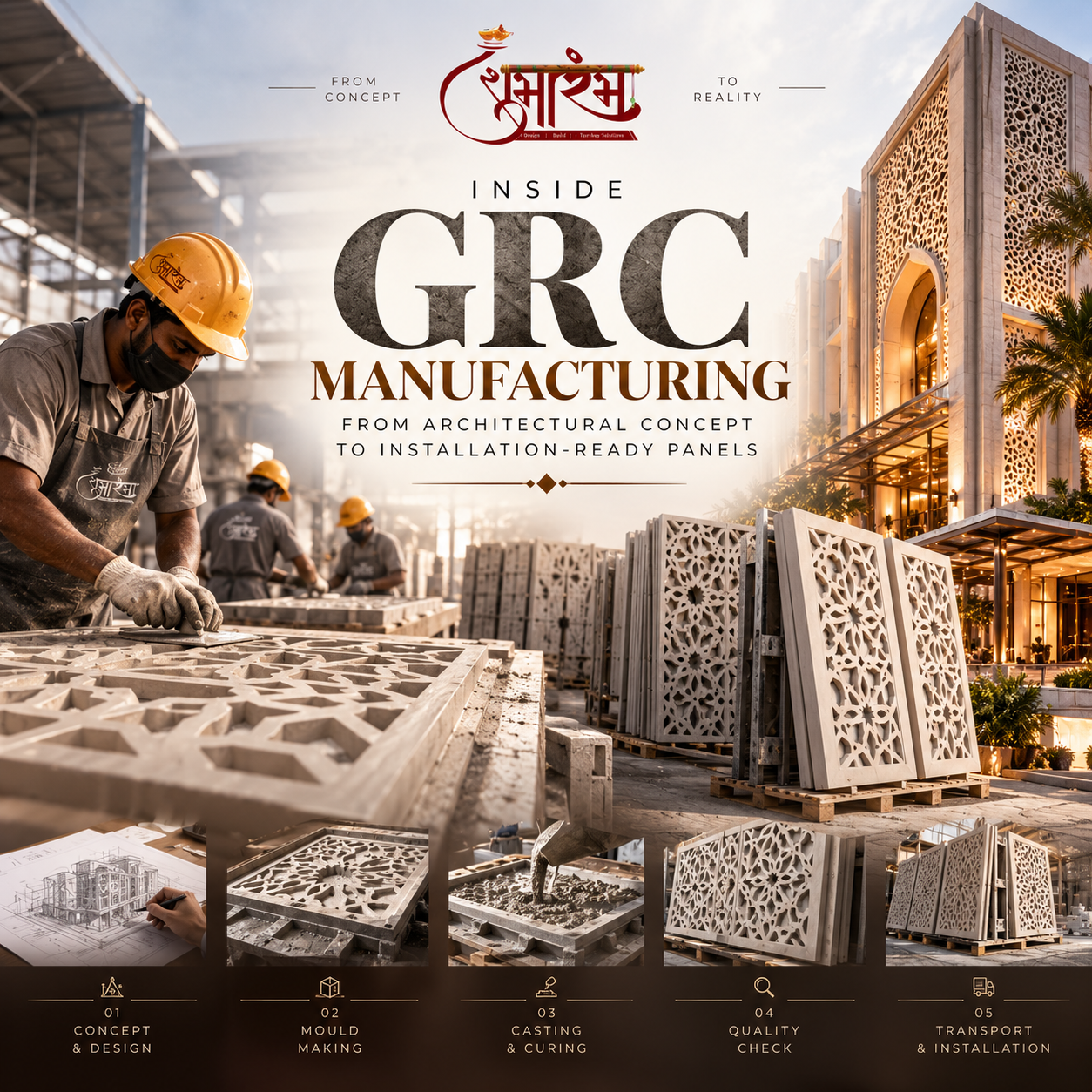
A reliable GRC package begins long before casting. Explore how design coordination, moulds, mix control, curing, quality checks and installation planning shape architectural panels for hotels and resorts.
Why manufacturing coordination matters
Architectural GRC can deliver intricate profiles and repeatable facade elements, but its success depends on more than the visual design. The manufacturing package must translate the architect’s intent into buildable geometry, realistic tolerances, manageable panel sizes and reliable fixing details.
Late changes to panel dimensions, openings, finishes or subframe locations can affect moulds, production schedules, transport and site installation. Early coordination helps the project team identify these dependencies before they become expensive site issues.
Step 1: Develop and approve the technical package
The manufacturer should receive coordinated drawings, panel schedules, finish requirements, project specifications and relevant structural information. Shop drawings should identify each panel, its dimensions, thickness, edge conditions, reinforcement approach, lifting provisions and connection strategy.
Design responsibility must be clear. The facade and structural teams should verify the loads, support conditions, movement allowances and connections for the actual project. A decorative panel should not be assumed to perform as a structural element unless it has been specifically designed and approved for that role.
Step 2: Mould preparation and material control
Moulds are selected or fabricated to achieve the required geometry, surface texture and repeatability. Their condition, release system, cleanliness and dimensional accuracy influence the finished panel. Complex forms may need trial pieces or a prototype before the production run.
Material batching and fibre handling should follow the approved manufacturing procedure. Mix proportions, fibre type, workability and placement method affect the finished product, so production records and consistent process controls are important.
Step 3: Casting, reinforcement and curing
Depending on the specified GRC process, the material may be sprayed into the mould or produced using a suitable premix method. Reinforcement and local build-ups must follow the approved design, especially around returns, inserts, edges and connection zones.
Curing and handling should follow the product specification and validated manufacturing procedure. Panels should not be demoulded, lifted or transported before they have reached the required handling condition. Production speed must not replace documented quality controls.
Step 4: Inspection and acceptance
Quality checks can include dimensional verification, visual inspection, finish consistency, checks around inserts and edges, and any tests required by the contract specification. Acceptance criteria should be agreed before manufacturing starts, not improvised after panels reach site.
Record non-conformances and their resolution. Where panels are repaired, the approved repair method should preserve the required appearance and performance. Samples and reference panels can help the team judge colour, texture and acceptable variation consistently.
Step 5: Packaging, transport and installation
Panels should be labelled to match the panel schedule and packed to prevent edge damage, abrasion and movement in transit. Delivery sequencing should reflect site access, lifting capacity, storage space and the installation programme.
On site, verify the supporting structure and subframe before fixing panels. Installers should follow approved drawings and method statements, maintain specified joints and tolerances, and inspect completed work. Sealants, drainage and interfaces with glazing or other cladding should be completed according to the system design.
Planning for projects in India and the UAE
Long transport routes, high temperatures, dust, humidity, coastal exposure and constrained sites can affect storage and installation planning. These conditions vary by project, so logistics and protection measures should be developed for the actual location and season.
For hotel and resort work, coordinate mock-ups and facade completion with waterproofing, external lighting, signage, landscaping and access systems. This helps avoid damage to finished elements and reduces conflicts between trades.
Conclusion
A dependable GRC package is the result of coordinated design, controlled manufacturing, documented inspection and disciplined installation. For hotel and resort developers, treating fabrication as an integrated part of facade engineering helps protect design intent, programme certainty and finished quality.