

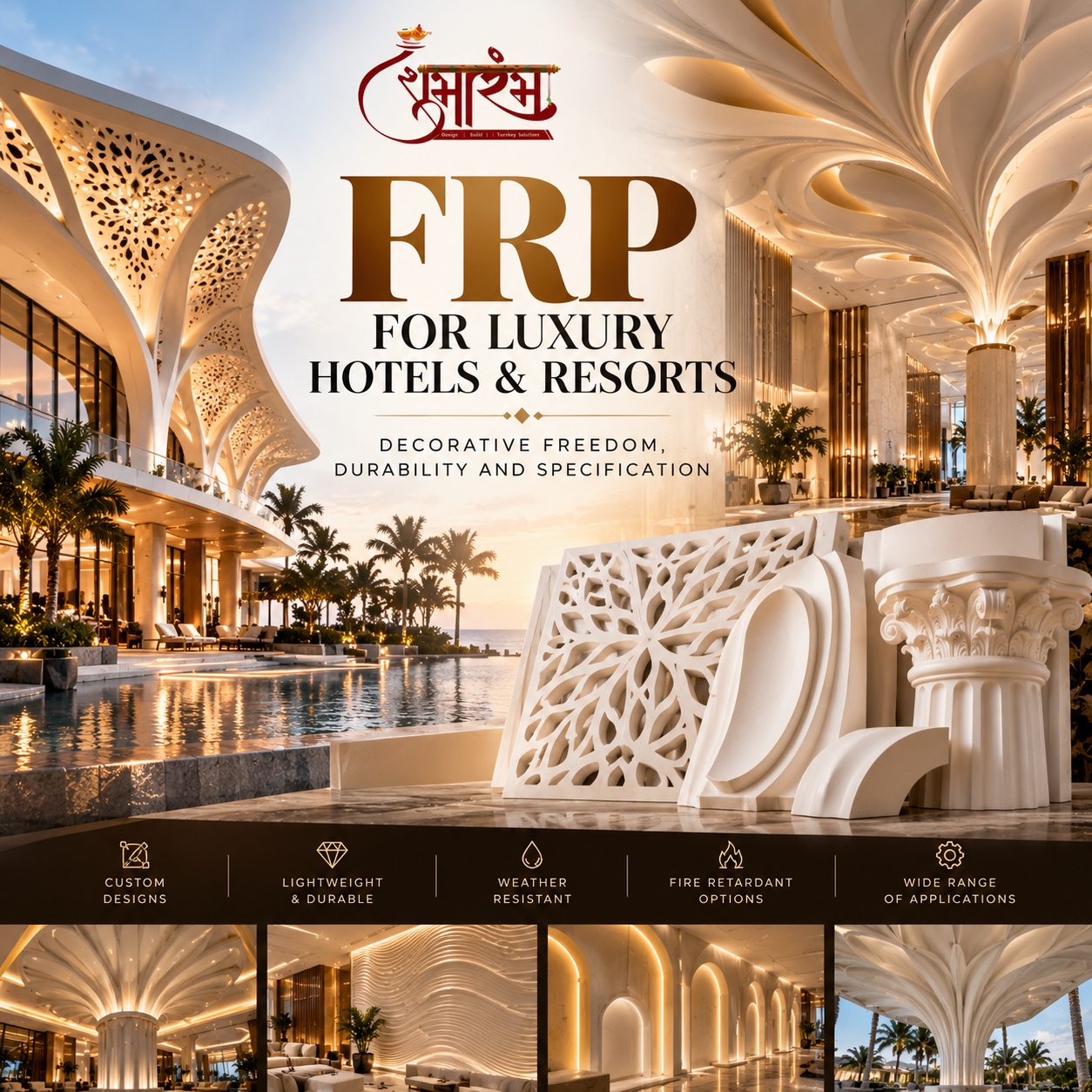
FRP can help hospitality designers realise intricate forms and themed environments. Learn where it may be appropriate, what to specify and how to plan fabrication, fire performance, installation and maintenance.
What makes FRP useful in hospitality design
Fibre-reinforced polymer is a family of composite materials in which reinforcing fibres are combined with a polymer resin. The final properties depend on the reinforcement, resin chemistry, laminate design, surface coating and manufacturing method.
For hospitality projects, FRP may be considered for bespoke decorative elements, themed installations, curved profiles, feature ceilings, selected canopies, signage and moulded components. Its value is often the ability to produce complex shapes with repeatable moulding, not a guarantee that every FRP product is lightweight, fire-safe or suitable for every exposure.
Potential applications across a hotel or resort
In arrival and lobby areas, moulded decorative features can support a distinctive design language when coordinated with lighting, access and cleaning requirements. In restaurants and event spaces, custom profiles and themed pieces can help create a recognisable atmosphere.
Exterior applications require a more demanding review. UV exposure, temperature cycling, wind loads, water ingress, attachment details and local code requirements must be assessed for the complete system. Some applications may be better served by GRC, metal, stone or another material.
Design for fabrication, not only for the render
Share the design intent early with the manufacturer. Confirm dimensions, part breakdown, mould strategy, transport limits, fixing locations, tolerances, finish samples and how joints will be concealed or expressed.
Large decorative forms may need to be split into manageable sections. The design team should review how these sections are aligned, supported, joined, sealed and accessed for future maintenance. A sample or prototype can reveal surface, colour and assembly issues before production.
Fire, heat, UV and safety requirements
FRP performance is system-specific. Designers should request relevant technical data and test evidence for the exact resin, laminate, coating and intended use. Where required by the project, verify reaction-to-fire or other fire-performance classifications with the responsible fire consultant and authority.
Do not assume that a generic FRP product meets the requirements of a hotel corridor, escape route, ceiling void, public assembly area or exterior facade. The applicable local codes, authority approvals and project specifications govern the decision.
Manufacturing quality and installation planning
Production controls should cover the specified materials, laminate build-up, mould condition, curing process, finish quality and dimensional checks. Acceptance criteria and repair procedures should be documented in advance.
Installation drawings should show the support system, fixings, joints, tolerances, access requirements and interface with adjacent construction. Confirm that the supporting structure is suitable and that lifting, storage and installation methods will not damage finished surfaces.
India and Dubai project considerations
In India, the relevant site conditions may include monsoon rainfall, coastal salts, humidity, dust and substantial variation between regions. In Dubai, high solar exposure, heat, dust, wind and project-specific fire requirements may be significant. Neither market has a single specification that fits every project.
Choose coatings, fixings and maintenance intervals based on the actual environment and product data. Include access for inspection and cleaning in the design, especially for high-level decorative installations.
Conclusion
FRP can expand the design vocabulary of luxury hospitality projects when the material is selected for a defined purpose and engineered as a complete system. Early manufacturer coordination, verified fire and environmental performance, quality-controlled fabrication and safe installation are essential to achieving the intended result.